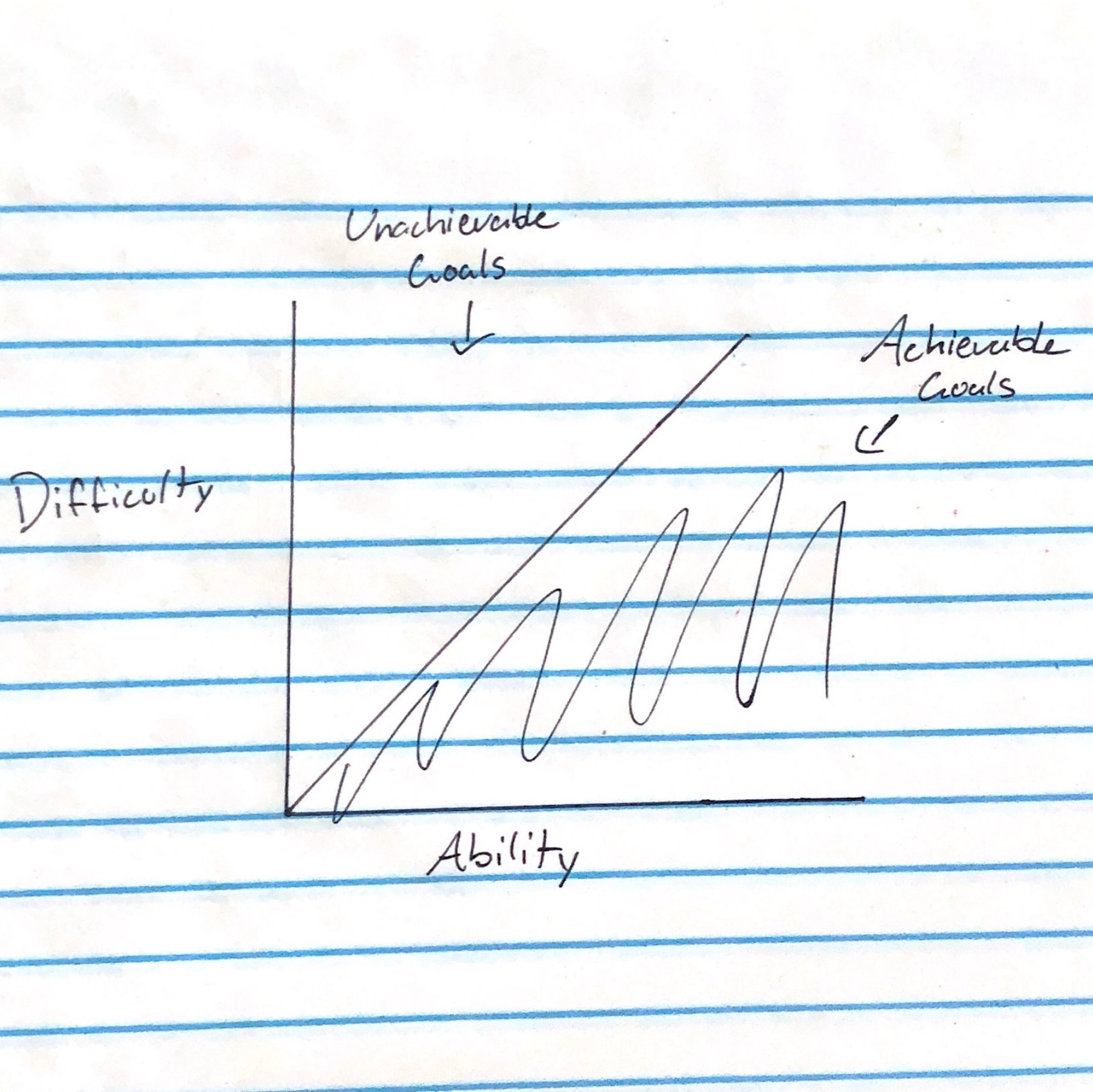
On goal space
Succeed! Fail! A lot!
If there are traits in a person that define how able they are to achieve goals of varying levels of complexity, it would make sense to encourage them to shoot to be closest to- without exceeding- that ability.
The image above shows the goal space. It is pretty simple, someone's ability defines what kinds of goals they can achieve. If ability outweighs difficulty, they may achieve the goal. The issue comes from the fact that the goal space is completely opaque to us. There are two confounding factors.
- I do not know what my own ability is
- I do not know where the ability/complexity curve actually lies
For example: I had no idea if I had the physical ability to do a backf lip (I learned that I do). I also had no idea how complex doing a back flip was (it is simple). It would be impossible for me to accurately place doing a back flip in the ability/complexity space, I have to go find out where it is (I did).
So a back flip is somewhere under my personal curve in achievable goals, but that gives me no information on where that curve lies. Nor would achieving every other goal I set- that would just tell me my curve was "somewhere up there."
Truly the only way to find the curve is to fail. Setting goals too complex for my ability will give me hits above the line. This paired with hits below the line map out the space.
So really this is my graphical rationalization as to why it is not only ok to fail, but necessary.